
Shamanista, Mama, MeMa, elder, metastatic cancer survivor, SoulCollage® facilitator, Sagittarian in the Ophiuchus window, snake clan, scar clan, now vulture clan, and a whole lotta other labels that don’t really contain me.
As the Western consciousness of shamanism increases there is an increasing interest and discussion around the concepts of shamanism. Within that discussion there seems to be a lot of misunderstanding, confusion, and disagreement about what a shaman is, what the role of a shaman is, what a shaman does, and whether anyone in a Western culture could ever even be considered a shaman. This article is an attempt to explore shamanism from various angles, cultural expressions, and beliefs. This type of discussion is something The Urban Shaman is deeply committed to facilitating, and although as an entity we hold an expansive and inclusive definition of shamanism, personally my own definition and understanding is likely a bit more restrictive and exclusive than common Western understanding would embrace. However, I don’t want to offer a precise, singular definition. I think it’s important to discuss the factors involved in molding a definition and that is my intention here. Before I dive into the topic I want to qualify that my voice is primarily experiential. I am not an anthropologist, nor do I consider myself an expert on shamanism. I have written about defining shamanism here and elsewhere and I encourage continued discussion. I am still learning, will always be learning, and I expect my ideas and beliefs to evolve. While I do consider myself a practicing shaman and have learned and continue to learn from various elder shamans both within and outside of Western culture, I also rely on book knowledge and various esoteric studies in contemplating what constitutes a Western shamanic model. And of course my direct experience with working with Spirits. The more I learn in practice the more open I become to the Way of Spirit, the Spirit of Shamanism.
Why Definition Is Important
As Western culture experiences all the negative effects of colonialism, industrialization, rational materialism, secularization, and politicization, our religious and spiritual systems become challenged to meet the growing existential need to find purpose and value, to find connection, and to make the  mundane into sacred. Many indigenous people the world over readily recognize that we here in the West have forgotten how to tend the soul, have forgotten how to make humans. And so within us exists this deep archaic impulse- an ache for what we have lost. This impulse not only compels us towards a community belonging, a village way of living, a deeper connection with nature and our immediate surroundings, and perhaps even an animistic view of the wonder of Creation, for some people this impulse also contains within it a shamanic impulse. The shamanic impulse, while connected to and integral to the archaic impulse, is also distinct. The shamanic impulse itself is much more individualistic (idiosyncratic). It doesn’t just seek to create a soulful and embodied wellness in the external environment and connections, it seeks to create this internally, for self and for others. And it specifically seeks to do this through tapping into the unseen world, the wild world of the Spirits, bridging between the two worlds to restore harmony to all. We see it expressed in all the healing arts, in magickal practices, in soul sciences. And perhaps this is what confuses people in thinking that shamanism is a mere spiritual path, a type of spiritual practice that benefits the self, a kind of self-expression. But one thing that immediately sets shamanism apart from this idea is that it is a role of service. To be a shaman is to be in a role of service. In the West the shamanic impulse compels some individuals to become priests, chaplains, psychotherapists, hospice and social workers, energy healers, massage therapists, ceremonialists, storytellers, artists. And in that way it is a universal human impulse contained within an archetypal constellation of characteristics. Archetypes transcend culture, transcend belief. The shamanic archetype is much more ancient and primal than the flavor of the day shaman and has survived all of the ages, whether we’ve been conscious of it or not.
And yet some cultures have retained a strong lineage and cultural practice of shamanism, where others have been splintered and suppressed. Part of this fragmentation of shamanism has been the consequences of imperialism, colonialism, immigration and assimilation, and part of it has been the consequence of intended suppression, mostly by political and religious forces. For cultures that have experienced the loss of their animistic roots and equally their loss of the shamanic role and practices, the impulses are compelling them to find new ways of expressing them. Herein lies the problem. We have very little to grasp in defining what shamanism even looks like because all the models left intact are so far out of our current cultural experience.
But why does this matter? In retrieving aspects of our individual and collective shamanic lineage while we build a new model of practice that’s appropriate for our time and culture, we cannot allow the toxins that have tainted our culture to equally leak into our understanding of what the shamanic role and practices should look like. In the depths of our collective dis-content with Western life the archaic impulse is intricately intertwined with the shamanic impulse. We really can’t have one without the other. So while shamanic practices must be translatable to our current culture, meet the needs of the culture and individuals within it, we must also come to a collective understanding of the difference between the shamanic and archaic impulses and how they compel shamanic individuals. We must not confuse things and must gain clarity about what actual shamanism is. This is especially important because the shamanic impulse can be far more prevalent than the fulfilled process of shamanic initiation. In other words- many are called but few are chosen. Or many experience the impulse and have found their way into various expressions of this, but aren’t actual shamans. It may not be that they’re not chosen as much as it is there’s no obvious role or path in Western cultures. And this leads us to become confused about what shamanism is, conflating the impulse with the role. Not everything is shamanism. And not everyone is a shaman. Even if we narrow this down to healing arts, not all healers are shamans. And in many cultures the shamans aren’t necessarily healers in the way we understand healing through an allopathic lens. It’s also important for those who may consider seeking shamanic assistance that they’re clear about what they can expect from a shaman and why they might benefit from shamanic work. And this is where a model of shamanic practice must be intimately tied to the culture, and what makes shamanism a very difficult practice in a culture devoid of animism.
A good analogy is a bowl of soup- in it’s entirety all the ingredients make up the soup (shamanic impulse), but each ingredient stands alone, is it’s own thing, and the soup can still be the soup if one  item is taken out or added. But we don’t look at chicken noodle soup, take out the chicken (the shaman), and then still define it as that. There are certain ingredients that define the soup and also distinguish it from other types of soup. And so it is with shamanism. We must come to a collective definition of what shamanism is, contrasted with what it is not- because carrots are not soup, and peas are not soup. They may be contained in the thing we’re calling chicken noodle soup (which ought to properly have at least chicken and noodles), but we can take peas and carrots out and standing alone they’re not shamans. Just as those we call a ‘medium’ is not a shaman. And yet shamans must have mediumship abilities. While some might argue that we don’t have a recipe so we can make anything we want, if we’re trying to retrieve fragmented aspects of real shamanic lineage and look to current animistic cultures that have stronger support for the shamanic role we have to take careful steps to follow some kind of recipe that is universal enough to be understood by all, yet also mindful of the local ingredients available to us.
The Definitive Spectrum
We know the word shaman is widely believed to have originated from the Tungus people/area. While the etymology of a word enlightens us to the original use and intention, the evolved and current use is the most relevant. And while cultures have their own languages and words for what we call shaman, the term seems to be taking on a more universal meaning. For example, in Mongolia the term büge is the noun for a male shaman, whereas idugan refers to a female shaman. Yet when speaking in English to Westerners a Mongolian will refer to either as shaman. There’s little doubt then that the word shaman encompasses what we could understand generally about the practice and role of shamanism in Mongolia. But the translation across languages can be tricky and doesn’t offer an absolute. For example, if a Mongolian uses the word shaman in speaking to English speakers, does this mean the practice of shamanism has to look exactly like Mongolian shamanic practices? This is not only why a universal understanding is important and perhaps cannot be exclusive to any one culture, it’s also why we cannot exclude cultural nuance in understanding the language or the actual practice. To understand how to define shamanism as a universal term we must both zoom in and zoom out to get the full picture.
Certainly Westerners long before us have extensively discussed a definition of shamanism. Eliade’s  Shamanism: Archaic Techniques Of Ecstasy is likely the most exhaustive attempt. I find this book to be comprehensive and fair- a middle road that offers both inclusions and exclusions. Eliade genuinely seeks to differentiate between many similar things/roles by comparing and contrasting. But not only was this work written more than 70 years ago (published in 1951), it’s not without it’s criticisms. Although I acknowledge this, I recommend anyone interested in shamanism to read Eliade’s work.
I characterize Eliade’s work as middle of the road because he takes an academic/anthropological view. As with all Western academics there’s a detached attempt at objectivity, an attempt to rationalize and thwart any subjectivity or especially spirituality or spiritual interpretation. Of course one criticism (and there are many) of the anthropological approach to understanding shamanism is that being outside of a culture looking in one can fail to comprehend the nuances of specific cultural expressions. That has less relevance to developing a universal definition of shamanism, but it has significant relevance to understanding the particulars of shamanic practice and how these might translate into a universal understanding. A good example of this is in the attempt of anthropologist Michael Harner to study shamanism all over the world, to draw elements of practice from each culture that shared a similar universal expression, and then to bring that to the West in the form of what is called Core Shamanism.[1] While Harner’s work has suffered many critics over the years, I believe it was his intention to not culturally appropriate specific shamanic practices. He didn’t want to teach North Asian shamanic practices to people in the West, for example, so he identified universal aspects of practices from many cultures and taught the core of those practices. This actually became a point of criticism because many see Core Shamanism as lacking the richness of lineage and depth of practice offered in specific cultural expressions of shamanism.
Moving from the middle to the right of the spectrum in defining shamanism there are the purist definitions. These definitions tend toward the basic assumption that the word shaman originated from the North Asian regions, which still maintain a strong shamanic practice, and therefore we must look to those practices in continuing to define what shamanism is. Furthermore, anything that does not resemble that closely in practice (not necessarily accounting for cultural nuances) is NOT shamanism. A fundamental problem with this language-dependent view is that the actual etymology of the word shaman is debatable and hasn’t been entirely settled. Furthermore, the word shaman is Anglicanized- it’s not even a word being used by the Evenki people (šamán).

Even if we dismiss the actual etymological evolution of the word shaman and just look at it’s original known regional usage we have to consider that shamanic practices don’t look exactly the same across cultural/tribal variations within the same regions. Another criticism of the purist view is that the North Asian (Siberian) etymology of the word shaman doesn’t negate that some forms of shamanism were in practice in different parts of the world at the same time. Of course they used different words to describe the practice/role, and of course they had cultural expressions that were very different. But the existence of the specialized role and the core of the practice (altering consciousness through a trance state to make contact with the Spirit world, or to invoke the Spirits) was the same. To assume that the title shaman can only be bestowed upon practitioners of a very specific regional expression of shamanism, and that anyone practicing some form of shamanism that’s outside of that culture is ridiculously exclusive and not in the Spirit of Shamanism. Spirits don’t stop at geographical borders or refuse to work with people not wearing the proper regalia or not reciting the proper mantras.
I believe Martin Prechtel offers a good example of some form of shamanism being expressed in Central America when he writes about his years spent with the Tzutujil people, integrating into their culture. He makes it clear that the culture is animistic, and there are roles for elders, chiefs, ceremonialists, each having their own initiations. He writes about the culture itself being centered around initiatory development, but distinguishes it from shamanic initiation:
“Initiation rituals were not done for the initiate’s benefit. They were done to keep the Universe alive for all of us. It was believed that in initiation by learning the ways of the language of each layer, and then doing the rituals of each, the world as a Diety would stay flowering and flowering, greased on the beauty of the rituals……….. Shamanic initiation, as described in my first book, Secrets of The Talking Jaguar, was a rare thing, happening to less than one hundred Tzutujil in a century. A very different kind of initiation took place for everybody else in the village, an initiation into adulthood and not to be confused with shamanic initiation.” – Long Life, Honey In The Heart
Not only does Prechtel make the distinction in the specific role and process of becoming a shaman in Tzutujil culture, he shares that their general word for shaman is Ajcuná (aj'kuna), generally meaning “he/she who tracks or finds it”, and that this word is translated into Spanish by the Tzutujil for non-Tzutujil people as abogados, meaning “lawyer”, but more specifically, “spirit lawyer.” Yet Prechtel himself consistently uses the word shaman throughout all of his published works in describing this unique role and initiation process during his integration within the Tzutujil world. Again, the evidence of differences in geographic region, religious influence, regalia, rituals, initiation processes, qualifications for the role, etc. should not negate the universal identification of a specific shamanic role found in many cultures across the world.

A strong advantage of the conservative definitions of shamanism is that they tend to place value on lineage, and the strength of the system, both of which can only be drawn upon within a firmly rooted culture (or subculture) that contains an active practice of shamanism. In such expressions the role and the methods of practice are clear. There’s no uncertainty about who is or who is not a shaman and the community agrees on this. The definition is held in regard and is maintained pristine in its agreed upon cultural understanding. There is something attractive about this and the sacredness that is guarded by excluding just anyone who comes along and wants to call themselves a shaman.
The obvious disadvantages of exclusionary definitions of shamanism is that they fail to take into account the crucial role that culture plays in the development of the shamanic role. The local mythos, cosmology, pantheon of deities, types and orders of Spirits- all of these things can vary significantly across cultures and will have observable effects on what the specific shamanic practice looks like in that culture. Additionally, there can be a lot of overlap in the role, as some cultures have many different types of healers and different names for each type, none of which singularly translate to shamanism, but some contain elements that are consistent with shamanic practices found in North Asia (for example, inducing trance to go into the Spirit world, making offerings to Spirits, etc.). When a definition is too conservative it misses the literal Spirit of Shamanism and discourages the retrieval of archaic practices that are made relevant to modern times. It denies the majority of people on the planet a claim to shamanism that is appropriate for their own cultures and times, and it’s disrespectful of the Spirits, whom I believe are knocking on the doors ready for us to open them.
Where Michael Harner attempted to identify universal consistencies in shamanic practices others have done the same in defining the role of the shaman and the shamanic individual. They have taken a wide lens in breaking down the various facets of the shamanic role and in the spirit of inclusivity and acknowledgement of the universality of human experiences they have tapped into an archetypal view of shamanism. This archetypal view is perhaps the left of center on the spectrum of shamanic definitions  and is by far the most liberal in its definition of shamanism. One significant advantage of this eagle-eyed view of shamanism is that it has no concern for specific cultural influences and expressions of shamanism and thus becomes timeless. The archetypal view seeks to understand shamanism as a global human experience that has existed for millennia, and the shamanic role as something that has ebbed and flowed throughout history and across regions based on many external factors, many of which have intentionally suppressed the shamanic impulse (religious missionaries framing archaic practices as savagery, for example, and shamans as witchdoctors, sorcerers, and evil). But even within the community that is exploring and holding an archetypal concept of shamanism there is some variety. Some see shamanism as a practice that is open and available to all. Others see it as a range where many people can be shamanic individuals and maybe even initiates, but far fewer actually pass through the crucibles of the initiatory process to become full-fledged practicing shamans. (See our previous interview with Andrew Camargo of The School of Modern Soul Science). And some quantify the shamanic archetype
  solely in terms of initiation and the process of shamanizing (for example, from a framework of The Hero’s Journey, as popularized by Joseph Campbell), where others (such as the groundbreaking work of Andrew Camargo) are describing the shamanic archetype in terms of functional characteristics and skills required to practice shamanism. The strength of this type of definition of shamanism/shamans is that it homogenizes many different specialties. For example, Archie Fire Lame Deer (Tȟáȟča Hušté), a Lakota Medicine man (Wicasa Wakan) and Chief, writes in The Gift of Power: The Life And Teachings Of A Lakota Medicine Man about the various types of Medicine Men and their specialties, and certainly the Tzutujil people had various shamanic-like specialties as well.

The archetypal definition of shamanism has it’s downsides. One is that it can be so liberal and inclusive in it’s view that essentially everyone is or potentially can become a shaman. While this detangles shamanism from culture and makes it a universal human experience, the danger is that without a proper lineage and elderhood, without specific teachings that frame and direct the skills into effective shamanic practice, it becomes so watered down it’s as if we’re just replacing the word spiritual with the word shaman. Another aspect is that the concept of archetypes is tied to Jungian psychological theory. While it’s a very Western approach to study and rationalize (ologize) shamanism and the shamanic individual, leaning too heavy on this system of study can take us too far away from the central fire that all of shamanism dances around- bridging between the material world and the Spirit world. It runs a high potential of defining common human experience as shamanic and turns shamanism into a psychology of sorts. And while it’s modern and threaded all throughout Western culture, it’s too far away from the archaic practices of shamanism to truly be considered shamanism.
The Universal Fabric: Understanding a Definition of Shamanism Through A Cultural and Historical Lens

When defining shamanism it's important to be clear that shamanism is not a religion, contrary to what some sources claim. It’s also not an alternative spirituality. To be a shaman is a specific role within the community and shamanism is the system of practice implemented in fulfilling the role. The foundation of shamanism is animism, which more closely resembles a religion and would be the common cosmological understanding for the entire culture. Animism is an earth-based spirituality that values all things in Creation as equal, whether animate or inanimate, and views all through a lens of the spirit qualities. Many people confuse shamanism with animism because by definition shamanism is animistic. But not all animists are shamanic. Because Western cultures are not animistic it creates unique challenges in developing a shamanic practice that meets the needs of Western people. We shamanic people in the West must become weavers, pulling in from many sources and experiences to develop our unique shamanic practices within the particulars of our over-culture and even our local and sub-cultures. We must become adept cross-cultural students of shamanism. We must rely more fully on the direction of Spirits and for those who doubt, this can lend to criticism about the lack of structure and skepticism about the true nature of the shaman’s relationship with Spirits.
We also have to consider that this notion of purity is misguided, as there likely doesn’t exist a pristine model of shamanism that pre-dates the Enlightenment Era (and all the isms that sprang from that). As much as the purists might prefer a strict North Asian definition of shamanism, even the Mongolian lineage, for example, has been damaged to some degree, as Manduhai Buyandelger discusses in her book Tragic Spirits: Shamanism, Memory, and Gender in Contemporary Mongolia (2013). Having learned a bit of Mongolian shamanic practices myself I know enough to know that it’s a very complex system, is almost entirely ritualistic (as different from what I would call ceremonial), is interwoven with Tibetan Buddhism (although it retains it’s animistic roots- Tengrism), and some of the shamanic practices would likely not be socially acceptable in the West. Even the shamanic regalia, while very specifically prescribed and accepted in Mongolian culture at large, would likely be considered overtly eccentric in the West. Indeed, this seemingly innate cultural fear and/or skepticism we have of the archaic, feral, even savage nature of shamanic practice may be tightly entwined with our colonialist roots and when considering how we define shamanism we can’t ignore the profound influence this has had in repressing the shamanic impulse and practices, and might unduly guide the definition of such.

So while North Asian shamanism is rich and has a lot to offer, it also poses limitations in translation to Western culture. Yet we can’t ignore this growing shamanic impulse, or the work the Spirits themselves are calling us to. For those of us in North America there still exists a strong cultural influence of Christianity, and while individual shamans may not relate to Christianity it’s likely that potential client/patients will have basic Christian cosmology ingrained within their ideas of what to expect from shamanic work- even if subconscious. (Some people claim Jesus was a shaman). As mentioned previously the barriers of rational materialism (versus animism, or magical thinking) are also greater in the Western cultures, restraining any understanding of shamanism through the over-reliance on science and rationality. Another aspect of Western culture that can get lost in translation is the strong over-culture influences of psychology, particularly in the self-help language. While this was discussed in terms of the dangers of an archetypal view of shamanism being conflated with depth psychology, there’s a deeper effect that the cultural pop psychology can have in confusing shamanism with psychoemotional healing, especially from traumas. People in the West often seek shamanic assistance because they’re struggling with psychoemotional and/or psychospiritual issues. A lot of these issues are symptoms of the larger cultural dis-ease. Yet we have to be careful not to conflate shamanism with trauma-informed psychotherapies. It isn’t universally true that shamanism is a form of healing in the way people in the West understand it or are seeking it, and we already have a plethora of roles and specific techniques to address these kinds of personal issues. Psychotherapists aren’t shamans and shamans aren’t psychotherapists. It’s not that they can’t be- it could be the shamanic impulse itself lead them into becoming psychotherapists. But the foundation and methods of psychotherapy are not shamanism.
While many shamans are adept healers, and the Wounded Healer is a central facet of many shamanic expressions, healing is not always a motivating purpose of shamanic work. Most often it’s a result of shamanic work. But the primary work is to diagnose the spiritual issue (even of physical injury or dis-ease) and then to mediate that between the Spirits and the patient, or community. For example, if someone suffers a bad fall with injuries it’s likely not the shaman who will set the bones and offer medicinal salves and concoctions. But it is the shaman who will divinate and/or directly consult with Spirits to determine the actual cause of the fall and mediate accordingly so as to appease the Spirits and prevent future traumas. So not only are shamans not psychotherapists, they’re also not universally herbalists or physicians of the physical realms.
And they’re also not holy men, monks, priests, chaplains, or bodhisattvas either- even though shamanism may contain aspects of these things (peas and carrots). Another thing for Westerners to consider in defining a culture-centered shamanic practice is the role that all the isms of cultural development have played in subverting the shamanic impulse, which as I’ve previously mentioned is intricately entwined with the archaic impulse. As I also previously mentioned the colonialist influences in defining shamanism, not just historically through the lens of anthropology, but even currently as we re-imagine what a Western shamanic lineage looks like, might tempt us to define shamanism (or specifically shamans) as much more sanitary and refined than they actually are in shamanic cultures. Consider some more insight by Martin Prechtel:
"The Tzutujil didn't have dynasties of shamans, or shaman families, they just showed up where the spirits decided, in all kinds of families. Tzutujil shamans were not Holy Men or Holy Women. They weren't virtuous gurus; they weren't required to follow anybody else's ideas of how one should be, other than what their own natural spirits indicated. In Tzutujil culture, the best shamans were not those who urged others to be like them. The villagers didn't care how holy the shaman was: they called on a shaman to help them fight oblivion, evil, and the sickness ravaging the land and their lives, to bring back the spirits' favor and grace into their daily lives. Shamans didn't do this by being good examples; they did it by their natures, which weren't altogether human, but natural. They had connections in the spirit world, connections regular people had lost because of overdomestication." - Secrets of The Talking Jaguar
We seem to prefer our shamans to be polite, disciplined, and fit within social norms. But this isn’t necessarily conducive to effective shamanism.

Another trap in defining shamanism for Westerners, particularly in North America, is to confuse shamanic practice with indigenous (First Nation tribal) spirituality and ceremonies. I’ve written elsewhere about how many First Nations tribes in North America never had a distinctly shamanic role in their culture. Certainly a Medicine Man is not the same thing as a shaman, just as a midwife isn’t necessarily a shaman. The overlaps can muddy things up and make defining shamanic practice more difficult. But likewise, without careful understanding there is a likelihood of missing the deeply shamanic elements, roles, and practice of a culture. Although overall the First Nations of North America don’t use the term shaman and don’t have a single designated role that precisely fits mano-a-mano, for example, a North Asian profile of a shaman, there are several indigenous North American cultures that held roles and practices that are undoubtedly in the vein of shamanism (the Yokuts, et al). Let’s take a deeper look at the Lakota People as an example, and specifically the role of the Yuwipi Man.[2] Archie Fire Lame Deer dedicates a chapter in his book sharing about the Yuwipi and the mystery of this shrouded Lakota ceremony (in some indigenous cultures a similar shamanic ceremony is known as Shaking Tent). Having read Yuwipi: Vision And Experience In Oglala Ritual and also having first-hand experience participating in a similar ceremony, the detached anthropological experience of such a sacred and deeply shamanic ceremony becomes disappointingly obvious. But there are some worthwhile anthropological accounts. I’ve yet to encounter any that tell the story from the experience of the Yuwipi Man himself- how he must go into trance, call
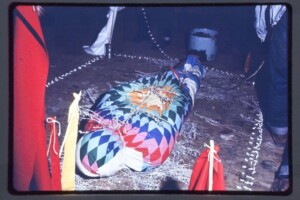
forth the Spirits, how his body becomes the offering, and the prayers and songs of the community in ceremony with him solicit the compassion of the Spirits, who then miraculously release him from his bondage. Yuwipi is different than any other participatory ceremonies of the Lakota, which can be facilitated by any designated Holy Man or Woman, because the Yuwipi Man (yuwipi wichasha) himself is a specialist among Medicine Men, especially called/initiated into this ceremony. Only he can become the ‘bound shaman.’ Only he sacrifices his body for the benefit of those in need of healing. While this ceremony is rich and complex in it’s layers and representation, a solid summary was found here:
“Among the Lakota, the shaking tent ceremony is called a yuwipi. The healer is tied up with ropes or leather thongs and a special blanket/star quilt while praying for the healing of a specific person or persons. The term yuwipi is usually derived from the Lakota verb form ‘they wrap him up.’ The healer is called a yuwipi man, who gives away a piece of his life every time he performs the exhausting ceremony, in order to serve the people and the Earth.
The yuwipi man mediates between the people and the spirit world. He is a wakan, a sacred person, who is not only a healer, but whose counsel is sought for family and business matters. He understands the languages of all creatures and can communicate directly with the spirits, who tell him how a patient's sickness may be cured.
The Lakota distinguish between white sickness, which can be cured by biomedical intervention, and Indian sickness, which is the result of disharmony between humans and the spirit world. The yuwipi man is the soul healer of Indian sickness.”
A more personal account of a Yuwipi ceremony is beautifully described here:
“Meanwhile, the singers, Justin and Jalen, completely covered Mike Jr. with a star-blanket and secured it with twine. His hands are tied behind his back, and twine bound him around his chest, waist, feet and neck. He lay facedown in the center of the altar, and the light was extinguished – it was completely black.
Then the singing began, the deep rhythm of the drum and the voices of the singers vibrated through the room. Almost immediately, sparks of white light burst from the altar, and crackled and danced throughout the room, accompanied by sounds of rattles. The sounds and light appeared and disappeared and reappeared so quickly that their source was impossible to conceive.
The song ended, and prayer began. Each participant was given the opportunity to offer prayers to the spirits. Many asked for the protection of ‘the man in the middle,’ who was offering himself as a vessel for the spirits; they prayed for their families, the people of Pine Ridge, the families and the land that supports them. As if in response to the pleas of the group, sparks, rattles and whistles filled the space around the speakers – an affirmation, it seemed to me, of the reception of the prayers by the spirits.
The prayers continued throughout the song, accompanied by lights and rattles and whistles all around and above me. Time disappeared. The space, the songs, the spirits were all there was. Finally, Mike’s voice echoed from the altar – no longer stifled by the blanket, that the ceremony had come to a close, that our prayers had been heard, and it was time to turn on the lights. Blinking disconcertedly in the sudden brightness, I looked around the room. Mike was seated in the center of the altar on the star blanket, unbound, the ropes neatly bundled beside him. Before him in a tight ball are the hundreds of prayer ties that had previously surrounded the space where Mike lay facedown. The larger flags were now lined up in front of him.”
Even in a purist definition of shamanism, apart from the geographical region and the etymology of the Anglicanized word shaman, the yuwipi wichasha is every bit the shaman- at least in how he assumes the role within this particular Lakota ceremony.
Zooming in on this particular ceremony demonstrated that when we approach non-Western cultures through a shamanic lens, holding honor and respect for the sacredness of the practices, we can likely identify a familiar shamanic theme that doesn’t have to be so broad as to include common animistic practices, but equally doesn’t have to be so narrow as to exclude practices on the basis of semantical rationalizations (the isms).
A Case For Unity
I’ve presented an argument for why a definition of shamanism is important, have laid out a linear spectrum model of existing definitions, and have discussed the nuances of culture and historical relevance in shaping current understandings and practices of shamanism. Now I want to turn a bit to a more philosophical and political argument for a universal understanding of shamanism.
Most Western cultures have suffered the loss of their shamanic lineages because of cultural fragmentation, caused by a variety of factors that would take a book to explore. I’ve labeled some of these in brief here. But those of us in North America in particular have a much less homogenous cultural identity- the United States is known as the “melting pot” of the world. And in assimilating into American culture many immigrants have had to suppress their own cultural understandings and practices. Over time this ‘melting pot effect’ has given us a variety of cultural expressions, but none that contain such vibrancy that they’re decidedly American (beyond consumerism and all the other isms). And so as we enter this period of shamanic renaissance, of exploring and expressing vast cultural differences, we have to be extremely conscientious of not misappropriating other cultures. This is a topic that’s been written about and discussed at length, so it doesn’t need any more explanation beyond just the acknowledgement that we can’t discuss a universal definition of shamanism and the cultural relevance without also prompting some humility in the process. I am still learning and growing, and so if I’ve made statements here that are offensive or seem off-mark, I ask for your grace as we learn together how to find peace and unity in this complex and wounded world.
If the very problems of Western culture have created this soul sickness then the only way for us to heal this is to embrace the archaic impulse first of all, and accept the return of the shamanic impulse as well. We need the help of the Spirits. We likely can’t do it without them. Imagine thousands of Buddhist monks meditating for world peace. And then imagine thousands of shamans working with the Spirits to bring harmony to the people. I heard Rak Razam say in Shamans Of The Global Village that if we had one shaman for every 100 people, with a population of 8 billion people that’s 80 million shamans we would need! With that level of need we can’t covet shamanism.
And so finding an ethical, safe, and grounded shamanic practice is imperative- for all of us. If one of us is sick, we’re all sick. And if one of us heals, we all heal. Excluding Westerners from a shamanic right not only is disrespectful to the Spirits, it discourages unity and peace among all humans. I fully believe we can find a way to restore shamanic practices to Western people without getting bogged down in the isms, and that with support of our non-Western shamanic brothers and sisters we can come to honor and respect the varieties of shamanic expressions and learn from them, and while honoring and respecting one another.
One last word on this- as I’ve mentioned many times, the archaic and shamanic impulses are intertwined. For Western cultures the archaic impulse has been buried under industrialization, technocracy, consumerism, and in large part the shamanic role for those in the West is equally to encourage and hold the space for the return to a more harmonious way of living on the earth. This might  look like earth-based spirituality, like animism, like indigenous ways of being. This in itself isn’t shamanism, but it’s a burden that seems necessary for shamanic people in Western cultures- perhaps part of the collective karma of colonialism. It really requires Western shamans to be cultural visionaries in addition to shamans so that they can effectively carve out the space that acknowledges the relevance of the Spirits in our lives. But the mixing of the two can appear to some to be an egregious trespass on indigenous cultures, a thievery of indigenous spirituality, and so we have to tread carefully here. While a universal definition of shamanism needs to exist outside of any specific culture and be inclusive of all expressions of shamanism, as we zoom into the development of specific shamanic practices in the West we have to be exceptionally conscientious of cultural appropriation and open to receive the fears, criticism, and anger of indigenous people.
A Final Encouragement for Westerners
In working towards a definition we have to understand we’re not reinventing the wheel. It’s not as if shamanism has ceased existing the world over and we’re re-creating a cultural role from a needy hole. There exists both a current and vibrant shamanic practice in many cultures and also a rich ancient thread that can be mined and brought forth to modern times. It’s really a task of blending, pulling from all the sources to reach a common and universal core of what constitutes shamanic practice and therefore what makes a shaman. But in the end, the definition and the word is best left to the rational mind. It’s a very Western way to be self-determined, to feel the need to have an identity, a title. As we learn about all the various languages, words, definitions, roles that constitute some kind of shamanic work all over the world we can understand that it is just a word, it is just a definition.
Some will say we have no right to call ourselves shaman in the first place. They’ll say it’s up to the community to call us shamans. The obvious problem with that for Westerners is we have no role for that and the common person doesn’t even know what a shaman is. It’s not likely Western people would refer to another Westerner as a shaman by recognition alone as there’s no context for that kind of relationship to begin with. And so many Westerners get caught up in this belief that they have to then create this community around shamanic understanding so that it is the community they created then recognizes them as shamans. The problem with this is it can lead to a ‘shaman cult’ where the main intention of the community is to acknowledge the shamans. This isn’t the natural order of shamanism, and is another example of the cultural sickness Westerners are suffering from, in my opinion.
In the end it doesn’t really matter if people in the general community or the communities you’ve created within the larger community call you a shaman, or if you present yourself as that. The real proof is in the pudding. It’s never been what we do or don’t call ourselves. Even if we ditched the word shaman altogether and decided upon a new term it wouldn’t change the work or our effectiveness in the work. The Spirits don’t care what we call ourselves or what others call us, or how we compare or contrast the different things. They just want us to honor them and do the work. And there’s certainly no lack of work.
_________________
[1] On another note, many people use the term core shamanism to loosely imply Western shamanism, a feral practice of shamanism, or even just simply drumming to induce shamanic journeying. As a several year student of Core Shamanism who has gone through nearly all the Advanced Three Year Program I would argue that Core Shamanism is an actual lineage of sorts, via the Foundation for Shamanic Studies. At the least it’s a particular unique system of learning shamanic practice and shouldn’t be used to describe any practice that is not learned from FSS. Just as people appropriate practices from other cultures without a full understanding of the culture or the practice, so too do people appropriate the practices from FSS without actually learning from the FSS system. In my understanding Core Shamanism was always meant to be just a foundation, hence the Foundation for Shamanic Studies. When taken in fully it offers a hearty beginning to shamanic practice and then from that point students who make it all the way through can find practitioners within other cultures from which to learn nuances and season their practices accordingly.
[2] Another example of the shamanic (contrasted with animistic) elements of the Lakota culture can be found in the story of Black Elk. Anyone who understands shamanism and reads Black Elk Speaks can see the strong shamanic elements that ultimately led to Black Elk becoming an infamous healer among his people.
 There are a hand-full of questions that I am routinely asked when people learn that I am a shamanic practitioner. The one that can be the most difficult to answer succinctly is how I got on this path in the first place. When I answer by stating that I was initiated in childhood I get a myriad of reactions. For shamans in contemporary cultures it can be difficult to identify the single moment of shamanic initiation. Many people don’t fully understand initiation to begin with, and the process in non-shamanic cultures can be convoluted and difficult to distinguish from circumstantial life experiences. This is what being involved with the
  independent and tenacious personality, she fell under his spell and in total we spent nearly five years of our lives under his violence. He perpetrated unspeakable things on me, on my mother. Very disturbing things. If you’ve ever read
  carrying out his threats- I watched him intentionally kill a beloved pet with his bare hands. So, not sure if her cries were indication she had been harmed, I peeled my frozen body out of the bed, quickly passed by the black hole the bathroom had become, and eased into her bedroom with trepidation. A soft bedside lamp was the only light in the room. The air was dense, heavy. Mom was sitting on the floor, clutching his arm, confused and distraught. I saw him sitting on the edge of the bed, his body hunched over, his neck contorted in an abnormal, nearly non-human positioning. His eyes were rolled up, only the whites showing. He had foamy saliva smacking in between his lips as he was uttering, mumbling really, incoherent words. It sounded like a foreign language to me, one I was unfamiliar with. Because the words had an intention, a felt meaning, it wasn’t just gibberish. Mumbled, or perhaps strained through this bizarre and altered state of consciousness, but defined sounds that carried a certain quality that told me he was actually saying or trying to say something I just couldn’t understand. Looking back with decades of adult experience, by psychiatric standards this scenario could likely be identified as some type of psychogenic seizure. But as a very young child enduring horrific abuses this looked and felt ominous, malevolent, like some sort of demonic Spirit had taken over my step-father’s body and mind. Why my mother didn’t call an ambulance that night, I don’t know. I suspect she saw little reason to, as his increasingly bizarre behaviors seemed to be attributed to psychiatric disorders. These are things I would never find answers to this side of the veil, as my mother had blocked out nearly all memory of our time with that man. She didn’t recall even having married him (the actual marriage ceremony). It didn’t help that all photo evidence of him was gone. It wasn’t until years after my grandfather died that I was able to find a photo my grandfather had kept in a file of mounting evidence against my step-father. My grandparents had hired a private investigator to help paint a clearer picture of who this man was and why he so consumed my mother’s and my life and so effectively isolated us, turning my mother against her parents.
 name as well, and he was very much alive during those years, even though my mother intentionally denied contact with her parents for the entirety of the years we spent with that man. Mom was very descriptive to me about her encounters with this shadowy Spirit named John who would appear to her at the foot of her bed. While I only caught glimpse of an apparition in my peripheral view once in that condominium, mom claimed to have regular encounters and believed John was some sort of guardian, or protector. So it was this heightened awareness of the Spirit realm and our ability to interact with it, witness the effects of it, coupled with the bizarre physical manifestations of my step-father and his brutal and malevolent behaviors towards my mother and me that opened my understanding and relationship with evil, with demons, with Spirits. While I can look back and explain away nearly all of the physical signs I experienced as childhood imagination, naivety, or misunderstanding, to this day I remain convinced that my step-father was demon possessed. I saw it in his eyes. I felt it. And I knew it wanted me dead.
 That step-father pursued me psychically for years after. I tried to return to a normal childlike state after that, but was never able to fully achieve it. Innocence was forever lost. Darkness had left it’s bloody handprint around my neck. And my psychic connection was like a downed powerline, whipping around in the wind. It was essential for survival in years prior, but having no consciousness around it, or how to turn it on or off, I had many moments when I would be caught up in the moment of just being a child and he would find me there. Like Danny in The Shining, I would freeze in terror, feeling so powerless and not knowing who to even tell about these inner experiences.
 It shouldn’t be surprising that by the time I was 13 years old I was involved with a 21 year old man. In 1988 we married- I was 15, he was 24. I guard details of specific incidents because they potentially serve to rouse malevolent Spirits, can cause secondary trauma, and hint at perceived triggers. I've already offered enough to illustrate the incredible trauma that can come from being initiated into darkness. Besides, a mage worth her salt will always guard close the treasure forged from the prima materia, lest another attempts to profane it and steal away her power. But suffice it to mention that this 9 year marriage was overshadowed by more of the same kinds of abuses I had suffered in early childhood, and some worse. And again, the spiritual overtones of those experiences were loud and clear. Some of the experiences I had in those 9 years were paranormal in ways I had not experienced prior and would not believe myself had I not had the direct experience. And other experiences were just obviously demonic. I learned first-hand what demons can do, how they can read our minds, know our darkest parts and try to trigger us, how they can effect the physical realm in tangible ways, how they can use the human vessel in profane ways, and push it to it’s capacities, how insidious and tricky they can be, and how insatiable their lust and perversions can be. I also learned how they can destroy a human being, in body, mind, and soul, and bring about utter chaos and confusion and even acute psychosis.
 It’s easy to make the connection of abuse and trauma with heightened emotions and thus irrationality, and even easier to dismiss the spiritual components of those experiences as hyperbole. But I had multiple adults around me during this time of my first marriage who just caught glimpses of my experiences and who were equally convinced that something of an overt spiritual nature was occurring and the presence was diabolical and destructive. They could see and feel it in my home and even identify particular areas, objects, photographs that contained malevolent energies. Some of them experienced the demons directly. So that validation grounded me, as the non-sensical psychosis about sent me to the brink of psychosis myself. Reality can get challenged when the spiritual manifests in the material, and a certain warping occurs even in the mundane aspects of life. When you live in a constant state of adrenaline that eventually takes its’ toll as well. It’s a slow erosion of mind, of body, of spirit. And even of soul. Many, many people who’ve had these kinds of experiences have not made it through the darkness. Many have succumbed to addiction, suicide, sexual enslavement, or have been given over to become perpetrators themselves.
 time as a forensic social worker. My caseload consisted of adults diagnosed with developmental disabilities who had been convicted of violent crimes- murder, rape, pedophilia, arson- and who had been let out of California’s developmental centers and placed in community settings. And while I knew since the time I was 11 years old that I wanted to be a psychologist or psychotherapist, when I started college (five years later) I had already honed that vision specifically into wanting to be a psychological profiler for the FBI. I had many books about the various serial killers under my belt, had read

 Berkowitz, John Wayne Gacy, etc.). And some people will be skeptical and believe that individuals use this claim as an excuse or defense to try to skirt accountability for their own free-will. I’m not here to convince anyone that demons exist or that evil originates from a different realm and perpetrates through humans. Truly my intention here is to share my own shamanic initiation, the first of many faceted initiations, and how that has affected my practice. But when people who have committed such inhumane atrocities as these serial killers have claim to have been tormented by demonic entities, I am a believer because I’ve stared into those soulless eyes, have seen the depth of suffering there, and felt the impulse that drives the insatiable need for more.
 labeling. And it runs a high risk of being tainted by projection. Healing from a place of the wound is far more damaging than just leaving well enough alone. But I’ve long contended that the urban shaman, the shaman practicing in contemporary culture needs to have a level of integrity and personal development that exceeds what one would expect from an indigenous shaman in a relatively untouched tradition. When people are living harmonious with the land and with one another they are far less exposed to the darkness. Every culture will have some acknowledgement of it, some myths around it, and some process for dealing with it. But they likely have far less direct experience with it. While in post-industrialized cultures we’re exposed to it constantly, are in positions to be influenced by it, and to also be conduits without ever knowing if we’re not discerning and introspective in our own processing. So when one has been initiated into darkness and directly experienced abuse and trauma, the process of developing discernment is often tangled up with those experiences. Therefore it’s much more imperative for the urban shaman to know thyself than it may be for indigenous, archaic shamans who live in completely different contexts then we are living in.
 have a central dogma that dictates belief and ritual, or a central worship of a godhead. It can seem incongruent that one shaman will say he doesn’t believe in demons while another actively does work with these malevolent entities (clearing them). But this really boils down to initiation. A shaman who doesn’t believe in demons likely just hasn’t had direct experiences with demons, as that isn’t his path. But the lack of direct experience doesn’t negate the experience of those who have. In the larger spiritual culture taking shape in contemporary societies this has created a conflict. On one side are those who’ve had direct experience with malevolent spiritual forces. They know the reality of evil firsthand and have experienced the duality. Their experiences have shown them that the darkness is far more than just a solipsistic projection of their own making. On the other are those who have had more mystical experience and have experienced the Oneness, the non-duality that is THE ALL.
 spiritual magnitude. My own pain and suffering has been necessary to my path, and I wouldn’t want to deny that same opportunity to anyone. But I also know I surely could have benefited from a corporeal teacher or mentor who might have helped me context my experiences, shown me the alchemical formula for transmuting all that lead quicker, and who would have countered some of that malevolence by speaking love into me. But it tends to go that those initiated into darkness through parental means (in childhood) often also lack the love and healing necessary to transmute those experiences into wisdom and service. We have to go a hard and lonely road with a lack of self-confidence and self-love. It’s no wonder that others who are going through initiatory crisis in the darkness are drawn to me. And I am honored to offer myself in that kind of work. But it just might look a little different than archaic shamanism, and intentionally so. That doesn’t make it less- less powerful, less effective, less shamanic. I rather think it makes me more- more precise in my specific shamanic expression, more aware of how that translates into the culture I am in, and more sensitive in harmonizing my techniques with the individual beliefs and experiences of those who seek my assistance.